Quantum Computing: What It Really Means for Grid and Critical Infrastructure Security

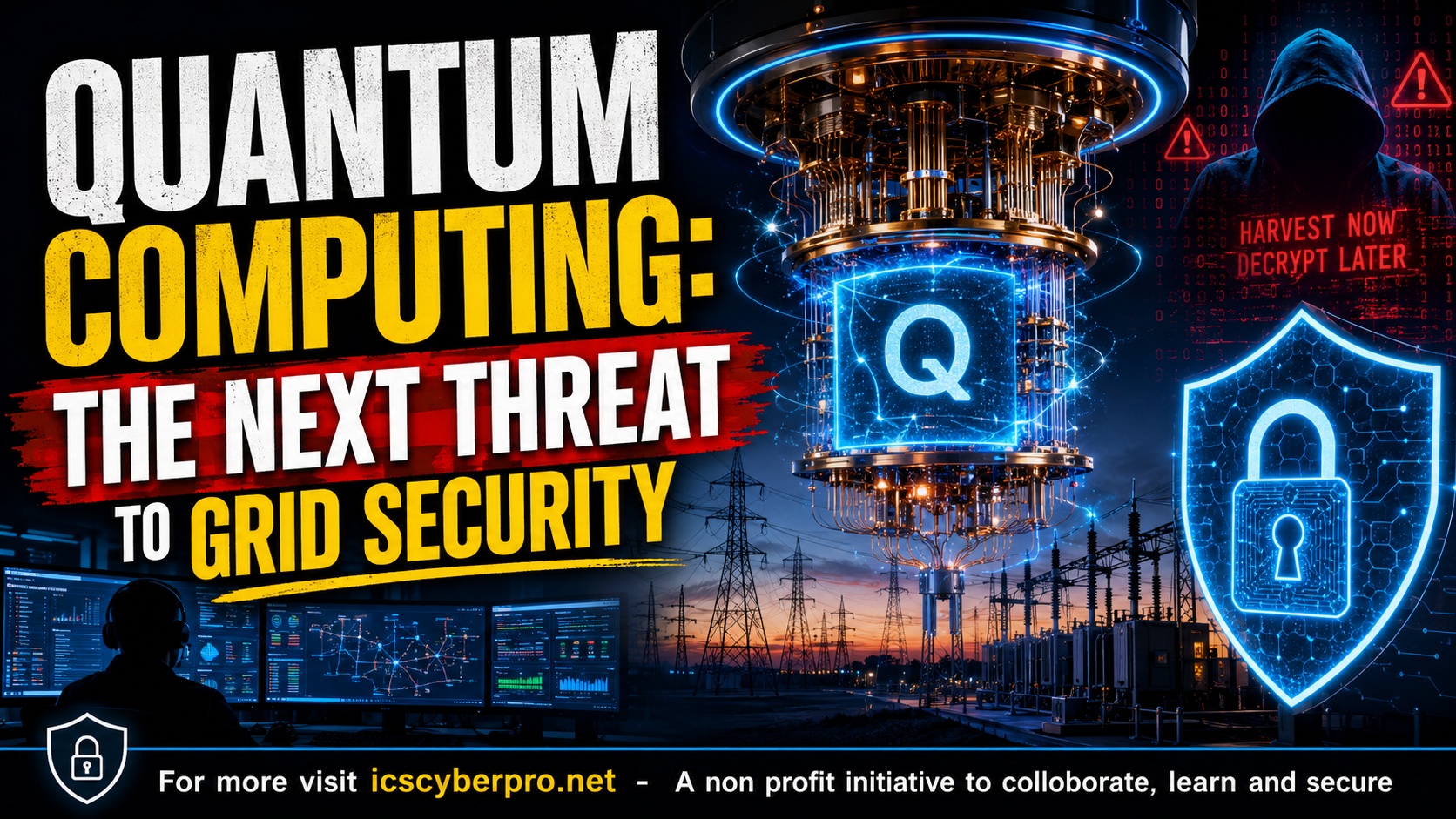
For anyone working in control rooms and SOCs, chasing down anomalies in substations, staying ahead of people who want to knock out power to a city, the usual worries are familiar- like phishing emails, unpatched HMIs, a contractor plugging in a rogue USB drive etc etc. Increasingly, though, a different concern is climbing the list and that is Quantum Computing. Here's is what i have learned about and trying to share in plain-language to breakdown, what it is and why it matters for anyone working near critical infrastructure.
First, What Even Is a Quantum Computer?
Every system used to run a grid, every relay, every RTU, every historian database, runs on bits. A bit is either a 0 or a 1. Simple, predictable, easy to reason about. That's the whole foundation of classical computing.
Quantum computers throw that out the window. Instead of bits, they use qubits, and a qubit doesn't have to commit to being a 0 or a 1. It can be a mix of both at the same time, a state call superposition. Stack enough qubits together and you get a system that can explore an enormous number of possibilities all at once, instead of grinding through them one by one like a classical machine does.
Then there's entanglement. Link two qubits together and they become connected in a way that changing one instantly reflects in the other, no matter how far apart they are. It sounds like science fiction. It isn't, it's measurable physics, and it's what gives these machines their strange power.
There's also something called interference, which is really just the engine that makes a quantum computer useful. Quantum algorithms are built to make the correct answers reinforce each other while the wrong ones cancel out, sort of like how noise-canceling headphones work with sound waves, except here it's happening with probabilities.
One catch: the moment you actually measure a qubit, it snaps into a definite 0 or 1. So the whole trick of designing a quantum algorithm is steering the odds so that when you finally look, you're very likely to see the right answer.
Why This Isn't Just Academic
Quantum computing has long been treated as a physics department curiosity, interesting, but decades from touching operational systems. Then Google's Sycamore processor ran a calculation in about 200 seconds that would've taken a classical supercomputer roughly 10,000 years. That moment, called quantum supremacy, is when many in the field stopped treating quantum as purely theoretical.
Where these machines really shine is in problems with enormous, tangled possibility spaces, simulating molecules, optimizing massive logistics networks, spotting hidden patterns buried in huge datasets. Useful stuff. But also, unfortunately, exactly the kind of horsepower that can be pointed at the math holding our encryption together.
The Part That Should Worry Every Grid or Critical Infrastructure Defender
Almost everything relied on to keep grid communications, vendor remote access, and control system traffic confidential depends on encryption, RSA, ECC, the asymmetric algorithms baked into countless protocols used without a second thought. That security exists because factoring huge numbers or solving certain math problems is essentially impossible for a classical computer in any reasonable amount of time.
A capable enough quantum computer running Shor's algorithm breaks that assumption. It can factor those large numbers and solve those hard problems fast, which means RSA and ECC, the backbone of most authentication and key exchange, stop being safe. There's also Grover's algorithm, which doesn't break symmetric encryption like AES outright, but it does cut the effective strength of the keys roughly in half, meaning longer keys will eventually be needed just to stay ahead.
This threat isn't waiting for the future, either. It's called Harvest Now, Decrypt Later. Adversaries, some of them nation-states with patience and deep pockets, are capturing encrypted traffic today and simply sitting on it. They don't need a quantum computer right now. They just need one eventually, and they're willing to wait years for it. Grid data, engineering diagrams, operational telemetry, and anything else with a long shelf life of sensitivity could already be sitting in someone's archive, waiting for the day the lock finally breaks.
What's Actually Being Done About It
This isn't a hopeless situation. The industry has been moving on this for a while now, and here's where the real work is happening:
Post-Quantum Cryptography (PQC), These are new encryption algorithms that still run on regular, classical hardware, but they're built on math problems (like lattice structures) that even a quantum computer struggles with. NIST has been leading the standardization effort, and utilities and infrastructure operators now face the task of migrating systems, substations, control centers, vendor interfaces, onto these new standards without breaking operational continuity. That's not a small task when some field equipment has a 15-to-20-year lifecycle.
Quantum Key Distribution (QKD), This uses the actual laws of physics to exchange encryption keys, and the advantage is that any attempt to eavesdrop physically disturbs the quantum state, making interception detectable. It's promising for high-value links, though the infrastructure to deploy it widely across a sprawling grid footprint is still maturing.
Quantum Random Number Generators (QRNG), Good encryption starts with genuinely unpredictable keys. Classical random number generators are, at the end of the day, deterministic, given enough insight, they can theoretically be predicted. QRNGs generate true randomness straight from quantum physics, which makes the keys built on them meaningfully harder to guess or reproduce.
The Hybrid Approach, This is the practical middle ground most serious critical infrastructure defenses are adopting right now: not ripping out classical cryptography overnight, but layering post-quantum methods on top of it, running both in parallel, so that even if one layer is compromised down the road, the other still holds. It follows the same core defense principle that's guided grid security for years: never rely on a single point of failure.
The Bottom Line
This isn't a call to panic-buy quantum-proof hardware tomorrow. Large-scale, grid-breaking quantum computers aren't operational yet. But "harvest now, decrypt later" means the clock has already started, and grid infrastructure has a nasty habit of running on equipment and protocols that outlive typical planning cycles by decades.
The threats worth worrying about are rarely the ones already at the door, they're the ones visible early enough to actually prepare for. Quantum is one of those. Taking inventory of where long-lived sensitive data and long-lived cryptographic dependencies live is a practical first step, and it's one that can start today, no quantum computer required.
References and Sources
This article was developed through an extensive review of academic journals, peer-reviewed research papers, technical reports, industry publications, and professional guidance covering quantum computing, post-quantum cryptography, cybersecurity, artificial intelligence, operational technology (OT), industrial control systems (ICS), smart grids, and critical infrastructure protection.
Key reference materials include publications from the Journal of Engineering Science, Global Journal of Engineering and Technology Advances, International Journal of Engineering Technology Research & Management, World Journal of Advanced Research and Reviews, Scienxt Journal of Computer Science & Information Technology, Career Point International Journal of Research (CPIJR), Technology Audit and Production Reserves, Eastern-European Journal of Enterprise Technologies, the Cloud Security Alliance (CSA), and other academic and professional sources. The article also draws upon multiple books, technical reports, and publicly available research related to quantum computing, post-quantum cryptography (PQC), quantum key distribution (QKD), quantum-safe cybersecurity, machine learning, SCADA security, and critical infrastructure resilience.
Disclaimer
This article is intended solely for educational and awareness purposes. It consolidates information from multiple publicly available academic and technical sources together with the author's professional experience in industrial cybersecurity and critical infrastructure protection. While every effort has been made to ensure technical accuracy, some concepts have been simplified to improve readability for a broader audience. Readers should consult the original publications, relevant standards, vendor documentation, and authoritative guidance before making engineering, operational, or security decisions.
AI Assistance Disclosure
To improve readability, grammar, sentence structure, and overall clarity, OpenAI's ChatGPT was used as an editorial writing assistant. The technical concepts, interpretation, structure, and final technical review were performed by the author. ChatGPT was not used as a primary source of technical information or research.